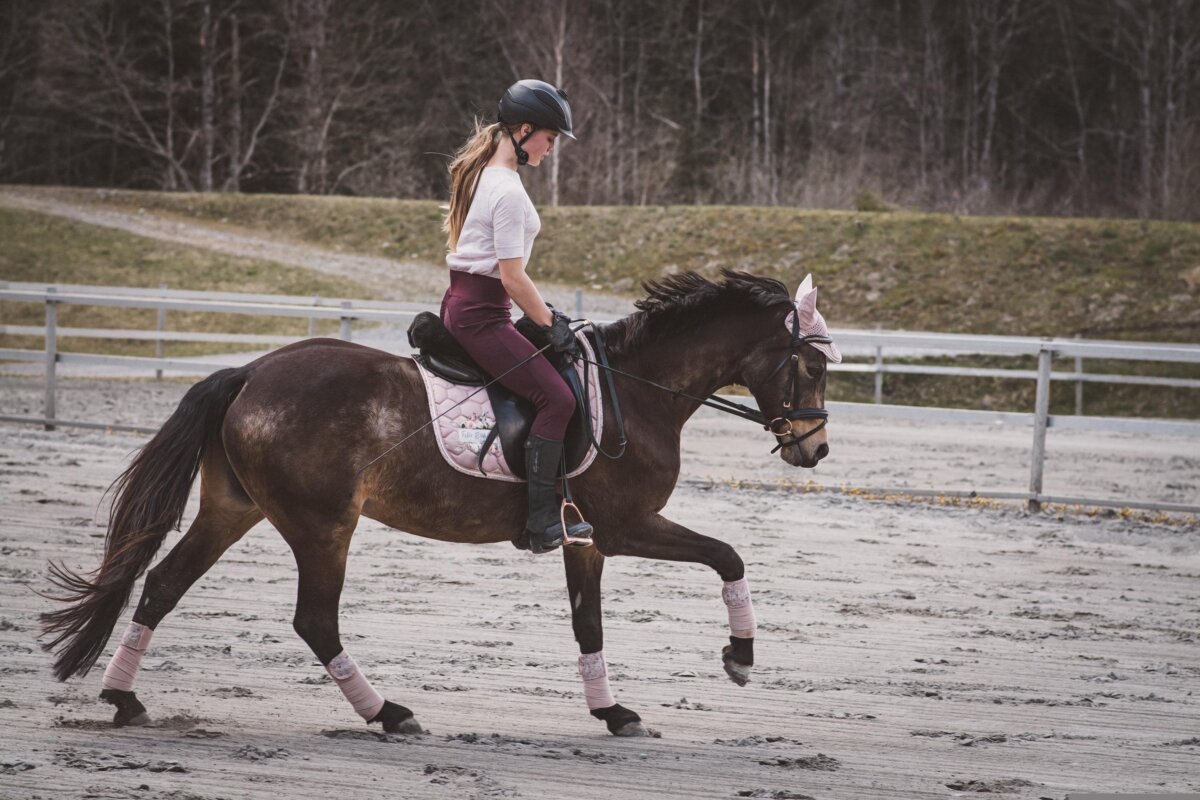
Okay, let’s talk about canter aids. And no, I don’t mean the movie version where someone kicks a horse twice and yells, “and AWAY we go.” A real canter aid isn’t a kick; it’s a handful of small, quiet signals lined up together at the same moment. Once you know what each one is and how to give it, your horse stops guessing and starts understanding.
Quick answer: the canter aids are:
- Outside leg behind the girth
- Inside leg at the girth
- A soft inside rein
- A half halt right before you ask
- Your inside seat bone nudging slightly forward
- Your horse staying slightly flexed to the inside the whole time
I know that probably reads like a foreign language right now, and that’s completely fine. Let’s break down exactly what each one means, how to actually do it, and how to practice it until it clicks.
The tools you’re actually working with
Inside and outside. Every canter happens on a “lead,” meaning one front leg and one hind leg reach further forward than the other pair with each stride. There’s no such thing as a horse cantering “straight” it’s always leaning slightly into one side. Whichever side that is becomes your “inside” (think: inside of the bend, inside of the circle), and the other side is your “outside.” So if your horse is cantering on the left lead, left is inside and right is outside, and the opposite if it’s the right lead.
Girth. This is the strap that holds your saddle on, wrapping under your horse’s belly. “At the girth” or “behind the girth” just tells you where on your horse’s side your leg should be sitting.
Leg means mostly your Calf. This is the lower part of your leg, from your knee down to just above your ankle. This is the part of your leg that actually talks to your horse, not your heel, and definitely not a kick. In canter, your lower leg lifts slightly and closes against your horse’s side instead of digging in or bouncing.
Flexion. This means your horse’s head and neck are very slightly turned toward the inside, just enough that you can see a sliver of their inside eye and nostril from the saddle. It’s subtle, not a full bend of the neck.
Gait. This just means the pattern of footfalls your horse is moving in, walk, trot, and canter are the three main gaits. Each one has its own rhythm and its own number of “beats” per stride (walk is four beats, trot is two, canter is three), which is part of why a canter transition feels like such a distinct change, you’re not just going faster, you’re switching your horse into a completely different movement pattern.
Half halt. This one trips up beginners the most because it sounds like it means “stop halfway,” and it does not. A half halt is a brief squeeze of seat, leg, and rein together that says “hey, rebalance, something’s about to happen,” without actually breaking the gait. Think of it less like a brake and more like a heads-up. If you want the deep dive on this one, FEI’s breakdown of the half halt is a genuinely good explainer.
Seat bone. You have two, and yes, they matter. These are the two points you actually sit on inside the saddle, and your horse can feel which one carries more of your weight, even through a saddle, even through breeches. For canter, your inside seat bone slides very slightly forward and down, becoming the “heavier” one for a moment.
The full canter aid, piece by piece
Here’s what’s actually happening, broken into the individual signals. Most of these happen in one single moment, not one after another:
- Flexion first. Your horse is already slightly flexed to the inside before you ask, so their body already knows which lead is coming.
- Half halt. A quick squeeze of seat, leg, and rein together, then release, right before you ask.
- Outside leg slides back, behind the girth. This is the leg that actually tells your horse’s outside hind leg to push off into canter.
- Inside leg stays at the girth, giving a squeeze at the same moment, keeping your horse stepping forward into the bend instead of falling in or out.
- Inside rein gives a soft, small give-and-take, just enough to keep the flexion without pulling.
- Inside seat bone slides slightly forward, becoming the heavier seat bone for that one moment.
That’s the whole coordination this aid is really about: not five separate steps, one combined moment.
Why your transitions aren’t clicking yet
If you’re doing all of this and it still feels like a mess, you’re not alone, this is genuinely one of the hardest things to coordinate as a rider. Here’s what’s usually going on.
- Bad timing. You’re asking, just not at the right point in the trot stride. This fixes itself with feel over time.
- Bucking. This one has a few different causes and is worth taking seriously instead of pushing through it. More on this below.
- Not enough preparation. Asking for canter out of a rushed, unbalanced trot is like merging onto a highway from a dead stop. Pro tip: If you want to be cantering by the corner of the arena, you need to start asking well before the corner, right after leaving the middle of the long side. Waiting until you’re already in the corner to ask means there’s no time left to prepare your horse or coordinate your own aids.
- Not sitting deep enough. If you’re perched instead of sitting into the saddle, your seat aid basically doesn’t exist yet.
- Leaning forward. This shifts your weight onto your horse’s front end, exactly the opposite of what a balanced transition needs.
- Heels and knees creeping up. Usually means you’re gripping with your knee instead of using your calf, which blocks the aid instead of giving it.
- Hands coming up. A classic “bracing for impact” move that pulls on your horse’s mouth right when they need the most freedom through their neck.
Almost none of these are your horse being difficult. Most canter problems are rider timing and position problems wearing a horse-shaped disguise.
How to actually practice this until it clicks
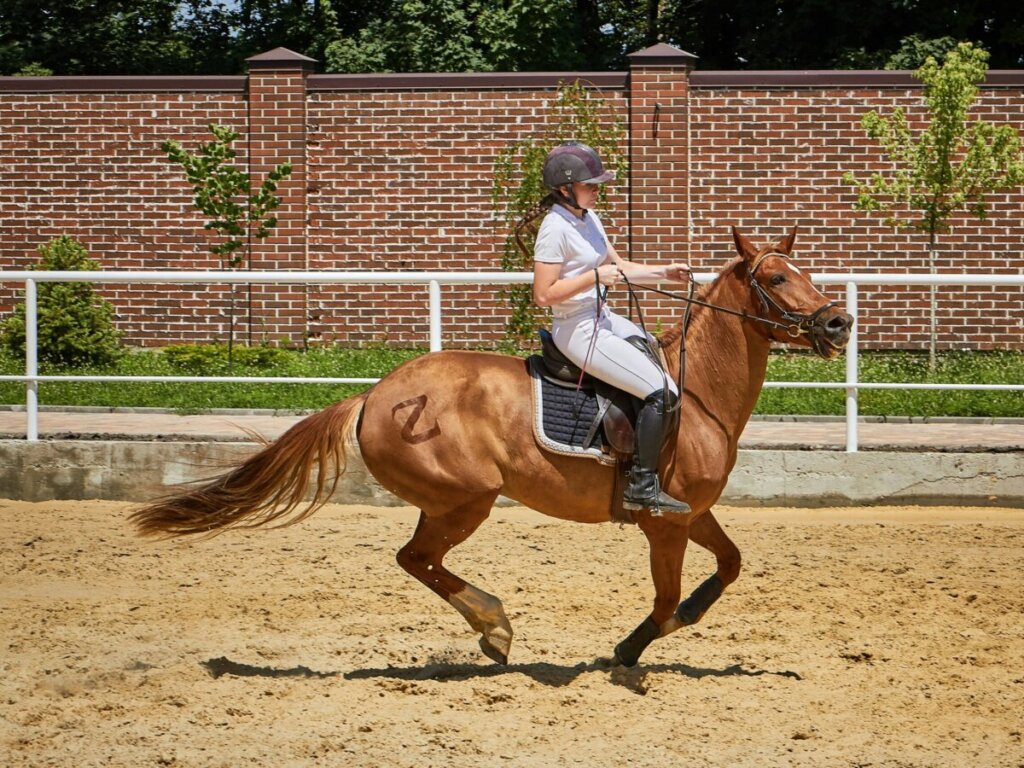
The trick that makes this whole thing click faster: practice each piece completely separately before you ever try to string them together. Trying to learn five things at once, in one moving transition, is exactly why it feels impossible at first.
- Practice your outside leg position on its own. Ride a circle at trot and just work on keeping your outside leg back behind the girth and your inside leg steady at the girth, without asking for canter at all. Get your legs comfortable being in two different places at once.
- Practice the half halt. You don’t need to be about to canter to practice a half halt. Use it before any change of direction, gait or any exercise.
- Practice flexion anytime, too. Walking around the arena, ask for a little inside flexion, hold it, let it go, ask again. This builds the feel completely separately from everything else.
- Do lots of walk-to-trot transitions. This sounds unrelated, but it trains the exact same coordination skill, asking with seat, leg, and rein together, at a slower, more forgiving pace where mistakes cost you nothing.
- Practice sitting on just your inside seat bone. This one is genuinely hard to feel at first. In sitting trot, you’re used to rocking your weight forward on both seat bones alternately, left-right-left-right, almost like swinging. Canter asks for something different: weighting only one seat bone, not swinging between both. A good way to build the feel is to practice at halt or walk, shifting your weight onto just your inside seat bone and holding it there, instead of rocking through both. That’s genuinely how I learned to tell the two feelings apart.
Once each piece feels familiar on its own, layering them together into one moment gets dramatically easier. You’re not learning five new things anymore; you’re just timing five things you already know.
What to do if your horse bucks when you ask for canter
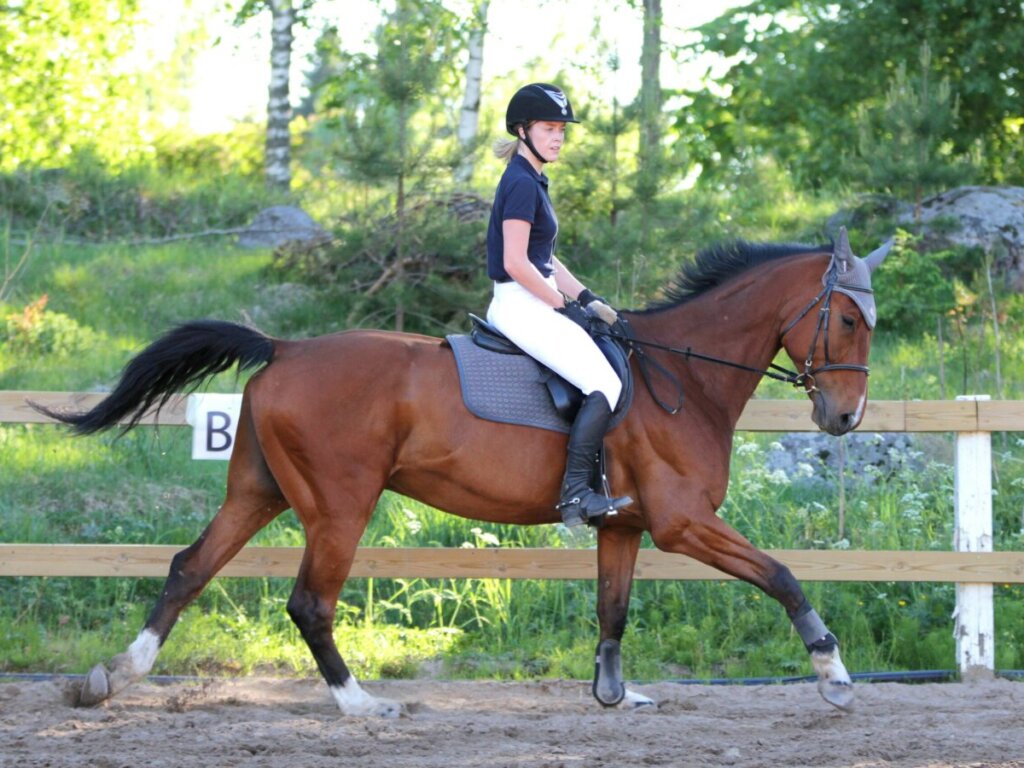
Bucking on the way into canter feels scary and personal, but it’s rarely your horse being naughty. It’s usually one of three things: physical discomfort (saddle fit, soreness, a check-worthy back), confusion from conflicting aids (like asking to go forward while also holding the reins tight), or a horse that’s been caught off guard because the aid came out of nowhere instead of out of a prepared trot.
If this is happening consistently, it’s worth ruling out pain first, then looking honestly at whether you might be giving a “go” and a “stop” signal at the same time without realizing it. This article on why horses buck when asked to canter walks through the most common triggers if you want to troubleshoot further.
Let’s Walk Off
Canter aids aren’t complicated once you break them down: flexion, a half halt, outside leg back, inside leg on, a soft inside rein, and your inside seat bone easing forward, all coordinated into one moment. Practice each piece on its own first, trust the timing more than the force, and the coordination comes. Your horse isn’t waiting for a bigger cue. They’re waiting for a clearer one.
FAQs
What are the canter aids? Outside leg behind the girth, inside leg at the girth, a soft inside rein, a half halt, and your inside seat bone moving slightly forward, all given together while your horse stays slightly flexed to the inside.
Which leg asks for canter? Your outside leg gives the actual canter cue by sliding back behind the girth. Your inside leg stays at the girth to support bend and forward movement. Basically both legs.
What does “inside” and “outside” mean in canter? Canter always happens on a lead, one side reaching further with each stride. Whichever side that is becomes “inside,” the other is “outside.” There’s no straight canter; it’s always one or the other.
Why does my horse buck when I ask for canter? Usually one of three things: physical discomfort, conflicting aids (asking to go forward while holding the reins tight), or being asked out of an unbalanced trot. Rule out pain first, then check your own aids and timing.
What is a half halt, in simple terms? A brief squeeze of seat, legs, and hands together that tells your horse “rebalance, something’s coming,” without stopping or breaking the gait. It’s a heads-up, not a brake.
Why won’t my horse pick up canter? Most often it’s timing: the aid is given at a moment in the trot stride where your horse physically can’t strike off cleanly. Practicing the individual pieces separately, then adding more walk-trot transitions, builds the timing faster than repeating the full transition over and over.
Do I need a perfect trot before asking for canter? You need a good enough trot: forward, balanced, not rushed. You don’t need perfection, but a chaotic trot will almost always produce a chaotic transition.

Leave a Reply