Disclosure: This post contains affiliate links. If you buy through them, I may earn a small commission at no extra cost to you.
Written with AI assistance, based on my own outline and notes.
Horses clipping sounds easy until you actually try it. But I know what to watch for, where beginners panic, and which parts of the body test your patience most. Let’s find out together how to make this less chaotic.
Quick Answer
Clip your horse if they sweat heavily during work and take forever to dry. A thick coat traps heat and moisture against the skin. Skip it if they barely sweat or live outside full time without a blanket. Start with the tricky spots first, while you’re both patient, and save easy areas for last.
In This Article
- Why horse clipping is about more than looks
- When to clip, and when to leave the coat alone
- What you need before you start
- What to actually wear on clipping day
- How to tie your horse so clipping actually goes smoothly
- Clipping horses’ legs, ears, eyes, and other tricky spots
- What to do if your horse really doesn’t like it
- Horse clipping for beginners: a step-by-step walkthrough
- A quick look at clipping styles
- Horse Clippers & Accessories
- FAQ
Why Horse Clipping Is About More Than Looks
A winter coat is built for standing in a field, not a hard hour of work. Exercise turns most of that energy into heat. A thick coat traps it against the skin instead of letting it escape. That’s the real point of horse body clipping. It helps your horse cool down properly, not just look tidy for a show.
Here’s the thing nobody explains clearly: a damp horse in cold weather isn’t just uncomfortable. It’s at real risk of catching a chill. Michigan State University Extension notes that clipping is also used for horses with Cushing’s disease. The condition can stop a horse from shedding its winter coat properly. That leaves them stuck in a coat built for a season that’s already over.
And no, clipping a horse won’t make them lose weight. It just means you can actually see their body condition without a foot of fluff hiding it.
When Should You Clip a Horse?
Not every horse needs it. Does your horse barely sweat, work lightly, and live outside without much blanketing? Then their coat is probably doing exactly what it should. Leave it alone.
But if your horse works regularly, sweats through every session, and takes forever to dry off, that’s your sign. Trapped moisture against the skin can lead to irritation, rubbing, or a shivering horse by the time grooming is done.
Most people clip first in early winter, once the coat has fully come in. They stop by late January before spring shedding starts. Clip too early, and you’ll have to redo it in a few weeks. Don’t forget every horse, area, and keeping conditions are different. All of these can influence the clipping times.
What You Need Before You Start
Beyond a good set of clippers, you’ll want gloves and clothes you don’t mind ruining. Maybe some treats; the horses would say it is non-negotiable. Ideally, bring a second pair of hands for awkward spots like the face and elbows.
One thing people forget: once you clip a horse, you’ve removed their natural insulation, so blanketing becomes non-negotiable. That’s a whole topic on its own, and I’ve got a full guide to horse blankets.
So, DIY, or do you call in a friend for backup? I’d love to know what your setup usually looks like.
What to Actually Wear on Clipping Day
Clipping produces a huge amount of loose hair, way more than a human haircut. It goes everywhere, including all over you.
Skip fleece. Those short, clipped hairs grab onto fleece fibers and barely come off, even after a full wash. Cotton isn’t much better, since the weave still catches short hairs and holds onto them.
What worked for me: plain denim. The hair brushed straight off, nothing stuck, and I didn’t care if it got a little dusty. Pick something with a tight, smooth weave that brushes clean in seconds. And pick something you don’t mind ruining, because clipping day is not the day for your favorite hoodie.
What To Do So Clipping Actually Goes Smoothly
Use a quick-release knot on a sturdy tie ring, on non-slip ground, same as you would for any grooming session. If your horse tends to get fidgety, this is where a treat bag or hay net earns its keep. Giving them something to focus on takes the edge off, especially the first few times.
When you get to the face, around the eyes and ears, tie with a touch more slack than usual. Your horse needs enough room to tilt or lower their head slightly. Too little slack near the face makes a nervous horse feel trapped, and that’s when heads start tossing.
If your horse has never seen clippers before, don’t just switch them on and go. Let them hear the sound first, then rest the clippers against their body while they’re off. Only then turn them on, near a calm area like the shoulder. Rushing this step is how you end up with a horse who dreads clipping day for years.
Check out my horse grooming kit guide. It covers the everyday tools worth having on hand, clipping day included.
Clipping Horses’ Legs, Ears, Eyes, and Other Tricky Spots
Clipping horses’ legs comes with its own learning curve. The skin around the joints is thinner there. Horses tend to be more ticklish and fidgety down there than anywhere else on the body. Go slow and use shorter strokes, and keep your hand steady even when they shift their weight around.
Ears are their own challenge too. Some horses genuinely don’t mind it; others act as if you’ve personally offended them. Support the ear gently with one hand, and keep the clippers moving instead of holding them still in one spot.
Eyes need the most care of all. Work slowly, and keep your free hand nearby to shield the brow if needed. Avoid sudden movements this close to the face. The same MSU Extension guide notes the head is usually the last and hardest area to clip. It recommends saving it for when you’re both calm, with a fresh blade for a gentler pass.
What to Do If Your Horse Really Doesn’t Like It
Here’s the part that trips up a lot of beginners. If your horse tosses their head or gets fussy, the instinct is to back off immediately. Hear me out, though, because that’s exactly the wrong move.
Stopping the second a horse reacts teaches them that fussing makes the clippers go away. That’s how a mildly unsure horse turns into a horse who fights clipping every single time. This is basic pressure-and-release logic, the same principle behind teaching a horse to lead or stand for the farrier. MSU Extension breaks this down well. The release has to come at the calm moment, not the reactive one. Otherwise, you reinforce the exact behavior you’re trying to avoid.
In practice, that means keeping steady, gentle contact through the fussing. Ease up on speed or pressure if needed, and only pause once your horse settles, even for a second. That pause becomes the reward. Over a few sessions, most horses learn that standing still is what actually makes the clippers stop.
Horse Clipping for Beginners: A Step-by-Step Walkthrough
Quick Note Before You Start: Keeping your clippers happy isn’t complicated, but skip it, and you’ll feel it, both in the cut quality and in your patience.
- Give the blades one last clean and oil before you put them away
- Oil the blades before you start, and again every few minutes while clipping
- Brush hair off after every pass, not just when you’re done
- If the clippers start getting uncomfortably hot to hold, stop and let them cool before continuing
- Using a corded clipper? Keep the cord away from water completely, no exceptions
- Loop or clip the cord out of the way so your horse can’t step in it or get tangled
Now You Can Start:
- Start clean and dry. Mud, sweat, or dirt in the coat will dull your blades fast and drag out the whole process. (Don’t do it after a sweaty session, and always groom before starting.)
- Tie your horse safely and let them settle for a minute before you even pick up the clippers.
- Introduce the clippers running, off the body first, so the sound and vibration aren’t a surprise.
- Start with the hardest areas while you’re both still fresh and patient — legs, ears, and the tail. Save the easy, wide-open areas for once you’ve both had enough.
- Clip against the direction of hair growth for a clean, even finish. (Except some tricky areas.)
- Check your lines at the end and clean up anything uneven, or accept the small flaws. A first clip doesn’t need to be perfect.
A Quick Look at Clipping Styles
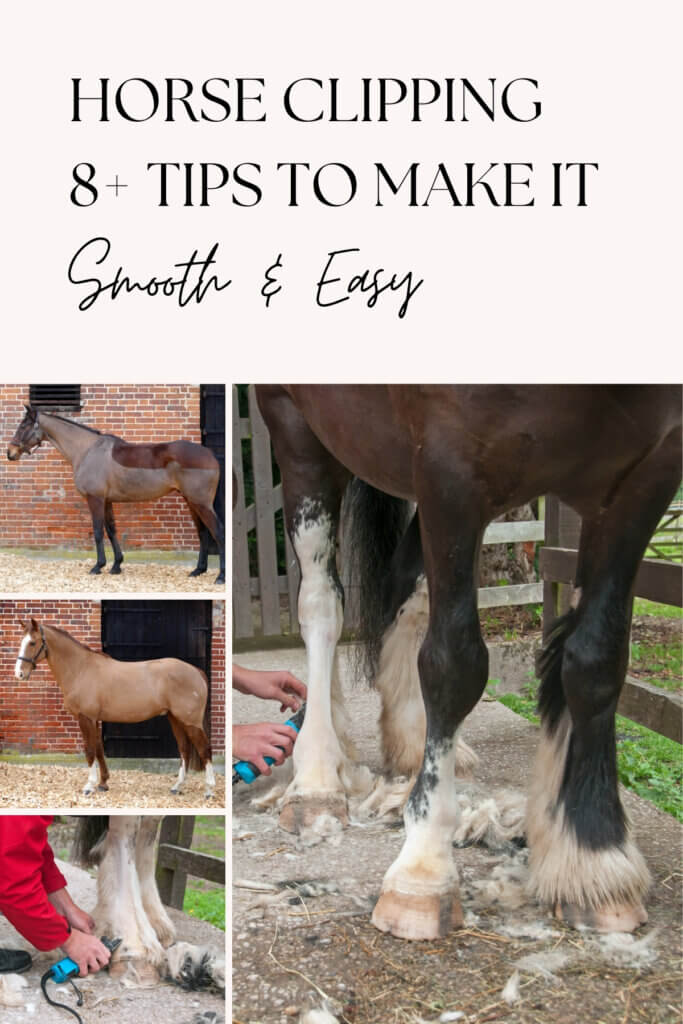
Full horse body clipping isn’t your only option. A trace clip removes hair from the underside only. A blanket clip leaves a saddle-shaped patch for extra warmth. An Irish clip runs a diagonal line across the body for lighter work. Full clips suit horses in heavy training, since they sweat the most and need the fastest cool-down.
Picking between them comes down to your horse’s workload and how much blanketing you’re willing to manage. I’m working on a full breakdown of every clipping pattern, with pros, cons, and which one fits which horse. Keep an eye out for that one.
Horse Clippers & Accessories
Quick note: these picks are based on specs and buyer reviews, not gear I’ve personally tested.
| Product | Best For | Amazon Link |
|---|---|---|
| Cordless Horse Clipper | Beginners, occasional full-body clips | View on Amazon |
| Pro Cordless Horse Clipper | Heavy-duty, frequent clipping | View on Amazon |
| Pro Horse Clipper | If you want a cheaper heavy-duty option than a cordless one | View on Amazon |
| Horse Clipper Maintenance Kit | Blade care & cleaning | View on Amazon |
| Rubber Gloves | To Brush Hair Off Easily | View on Amazon |
FAQs
Do I need a professional, or can I clip my horse myself?
Plenty of people do it themselves, and it’s genuinely fun if you like spending extra hands-on time with your horse. Get help for the tricky spots or your first time. And if clipping day feels like a fight instead of a chill bonding session, just call a pro.
Does horse clipping help with weight loss?
No. It just removes the coat that was hiding their actual body condition, so you can finally see what’s underneath.
What’s the hardest part for someone doing horse clipping for beginners?
The face, tail, legs, and the elbows.
Will the coat grow back the same after clipping?
Yes, clipping doesn’t damage hair growth. The coat regrows at its normal rate and texture. It might look a little different until it’s fully back in.
Is clipping a horse the same as trimming?
Not quite. Clipping removes coat from larger areas of the body for temperature regulation. Trimming usually refers to smaller touch-ups, like tidying the muzzle, bridle path, or fetlocks.
My horse hates the clippers. What now?
Slow down, but don’t quit the moment they fuss. Reintroduce the clippers off first, then on, but away from the body. Build tolerance over several short sessions instead of one long one.
Ride Off With This in Mind
Horse clipping isn’t complicated once you know what you’re looking at, but it does take patience, especially the first time. Start with the tricky spots while you’re both fresh. Go slow around the eyes, ears, and legs, and don’t stop the moment your horse fusses. Don’t stress if your first tail looks a little questionable, either.

Leave a Reply