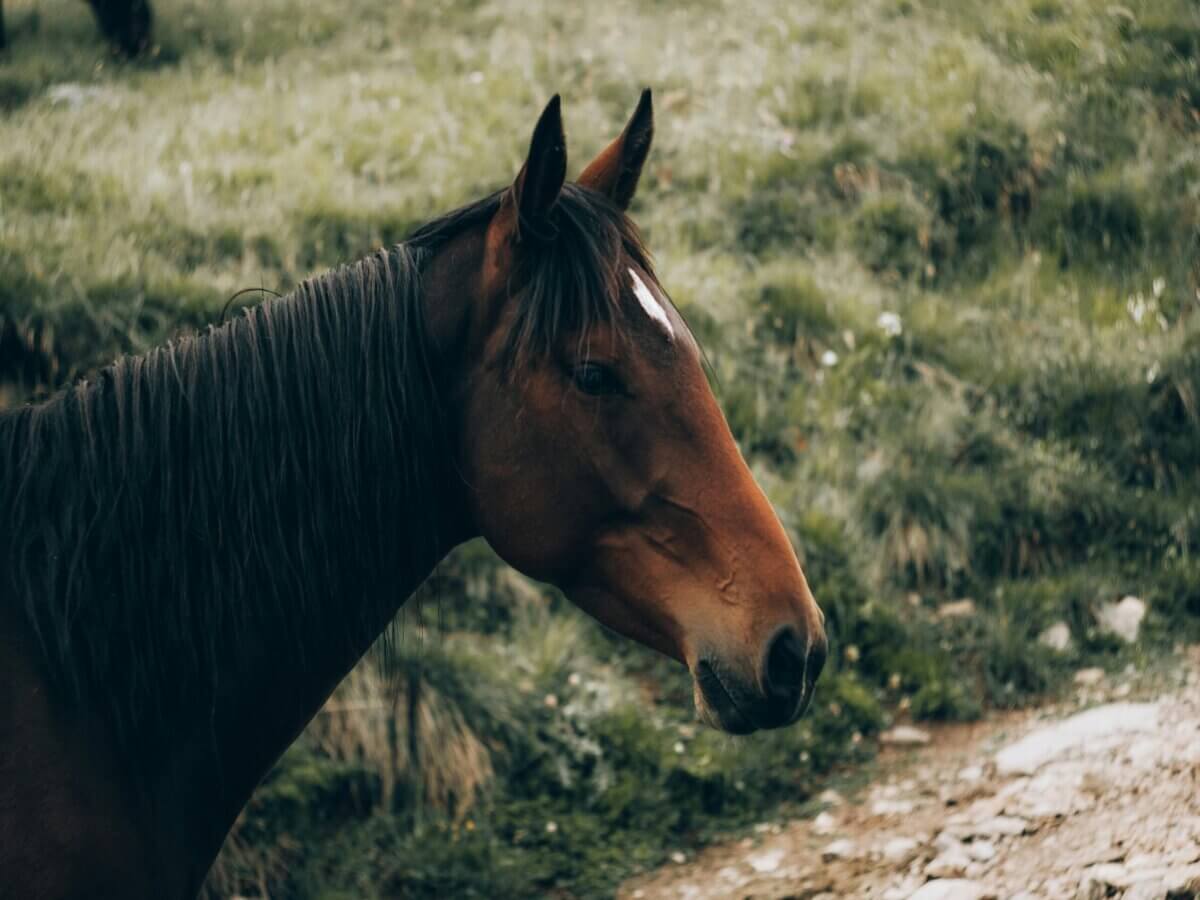
Horse vision is totally different from ours.
A plastic bag. A falling leaf.
And suddenly your horse is acting like the world is ending.
What just happened?
Why do horses react to things we barely notice?
And how can we use this to work better with them?
Let’s dig in.
Your Eyes vs. Horse Eyes: A Tale of Two Systems
Your eyes sit at the front of your face. That gives you around 180 degrees of vision. You use both eyes together for sharp focus and depth perception. Only about 1 degree is truly in sharp focus at any given moment. Everything else is peripheral.
Horses are completely different.
Their eyes sit on the sides of their head. This gives horses a total visual field of approximately 350 degrees. Almost a full circle. That’s a serious survival advantage for a prey animal.
But here’s a thing:
- Most of what they see is monocular — one eye at a time
- Their binocular zone (where both eyes overlap) is only about 65–80 degrees directly ahead
- Sharp focus is limited to a small band in front of them
They live in a world built on motion detection, not fine detail. Horses’ vision is not quite as sharp as ours, but better than that of dogs or cats. The real difference is how they process what they see.
The Blind Spots You Absolutely Need to Know
Even with 350 degrees of vision, horses have two blind spots. And these matter a lot for your safety.
Directly in front of them
There’s a narrow blind zone right below the nose and immediately in front of the forehead. If you stand too close, straight ahead, your horse literally cannot see you. Step slightly to the side and give them a little distance.
Directly behind them
This is the danger zone. You already know this, but worth repeating. Horses can kick fast and hard. If they get startled, you don’t want to be there.
If you have to be behind them:
- Talk to them so they know where you are
- Keep a hand on their body so there are no surprises
- Move slowly and predictably
How Sharp Is Their Vision, Really?
Horses see most clearly at about 1 to 1.5 meters in front of them. Beyond that, things get blurrier and more movement‐based.
Research shows they need to be about 50% closer to an object to see it in the same level of detail we do. That’s why horses:
- Lower their heads to inspect things on the ground
- Take time to focus before approaching jumps
- Sometimes need a moment to understand new objects
And since they are prey animals, their brain defaults to: if it moves, treat it as a threat first. Ask questions later.
Why Your Horse Keeps Spooking at the Same Old Things
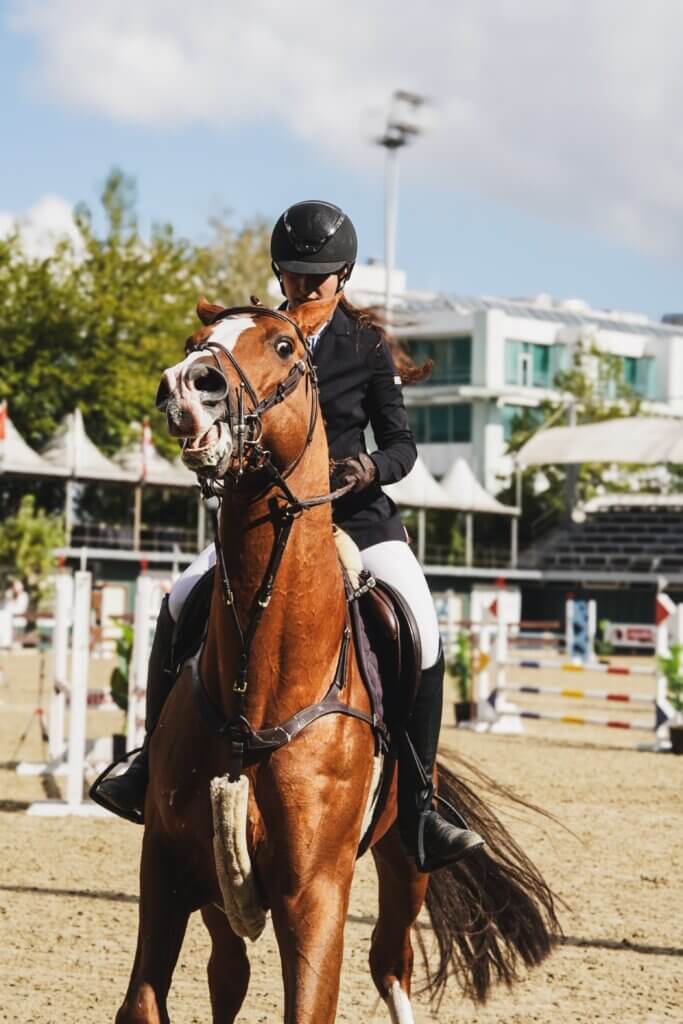
You’re riding on a calm afternoon. Everything is fine.
Then: tension. Wide eyes. Full stop.
That object was there yesterday. And last week. But today it moved. Or the light caught it differently.
For you: it’s just a basket.
For your horse: it’s an unknown moving thing. Possibly dangerous.
Research confirms that horses have evolved to react first and assess later. Their wide visual field is designed to detect movement, but identifying what caused that movement is a secondary step.
Interesting side note: studies also show horses react more strongly to novel objects seen with their left eye than their right. This is linked to how the brain processes potential threats versus familiar stimuli.
My personal favourite horse‐eating monster? Light reflections on water. Absolute chaos every time.
Tell me in the comments what your funniest horse-eating monster story is!
What to Do When Your Horse Spots a Monster
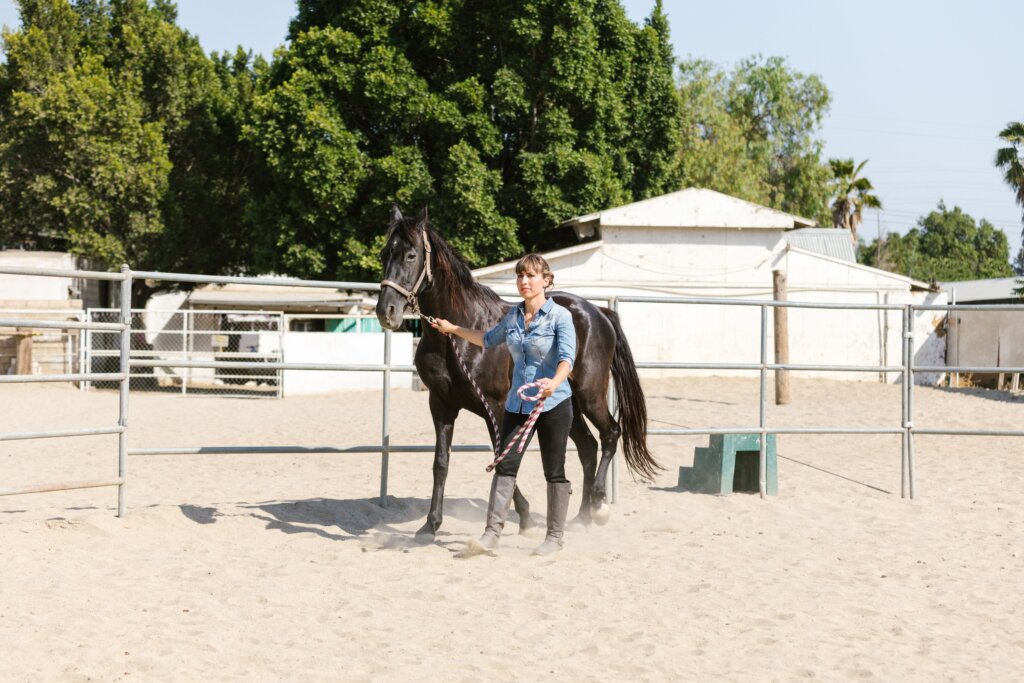
It depends on the situation.
If it’s safe to approach:
- Let your horse move toward the object in their own time
- Get within that 1 to 1.5 meter clear vision range
- Let them look, sniff, and breathe
- Stay calm, talk gently, and give them time
Your goal isn’t just to get past the scary thing. It’s to teach your horse that new objects are worth investigating, not fleeing.
If your horse is bolting or you feel unsafe, don’t push it. Get help from a professional trainer. Desensitisation work makes a real difference between a permanently spooky horse and a genuinely confident one.
Can Horses See in the Dark? Better Than You Think
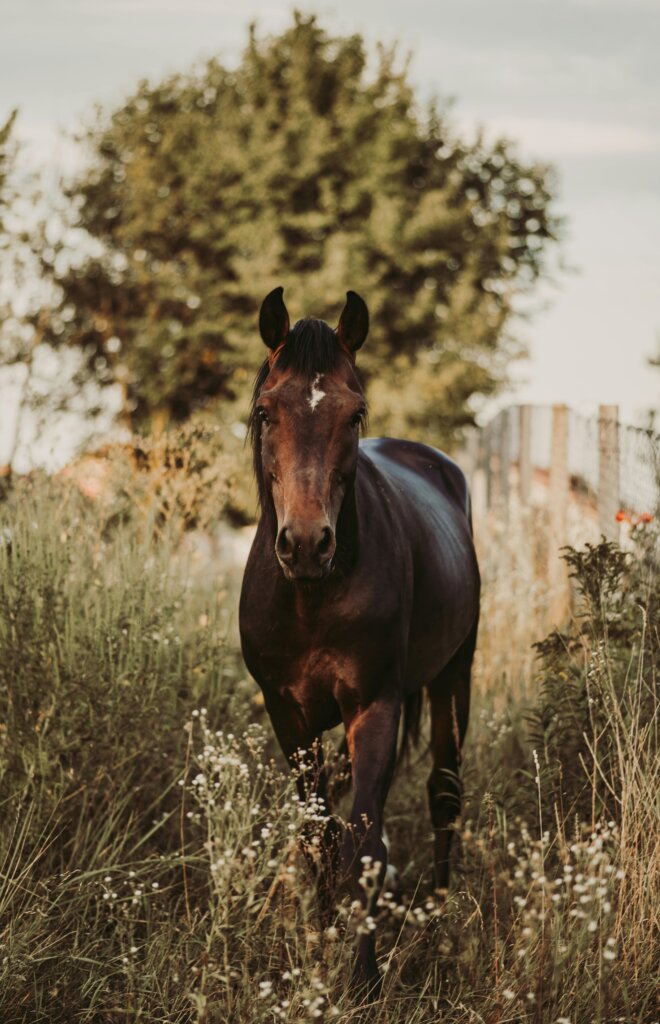
Yes, and significantly better than us.
Horses have a much higher ratio of rods to cones in their eyes (roughly 20:1 compared to humans). They also have a tapetum lucidum, a reflective layer behind the retina that bounces light back through the photoreceptors for a second chance at detection.
That’s why their eyes glow when you shine a torch at them at night.
According to equine vision research, horses can navigate safely even in near-darkness. Under a full moon, they see almost as well as in daylight.
Side note: They struggle with sudden light changes. Going from a bright arena into a dark barn, or stepping from shade into direct sun, takes them much longer to adjust than it takes us. So be mindful:
- Give them time to adapt when moving between light and dark
- Move slowly when loading or entering buildings
- Don’t expect instant adjustment; it’s not stubbornness, it’s biology
What Colors Does a Horse Actually See?
Horses are not color blind. But they don’t see the full spectrum either.
In practice:
- Blues and yellows: clear and well-distinguished
- Greens: visible but not as vivid
- Reds and oranges: appear as a muddy brownish-gray
That bright red jump you love? Your horse probably sees it as a dull smudge.
This also means that if you’re trying to mark anything in your horse’s environment for visibility, use blue or yellow, not red.
Blue Eyes, Brown Eyes: Does It Affect the Vision of Horses?
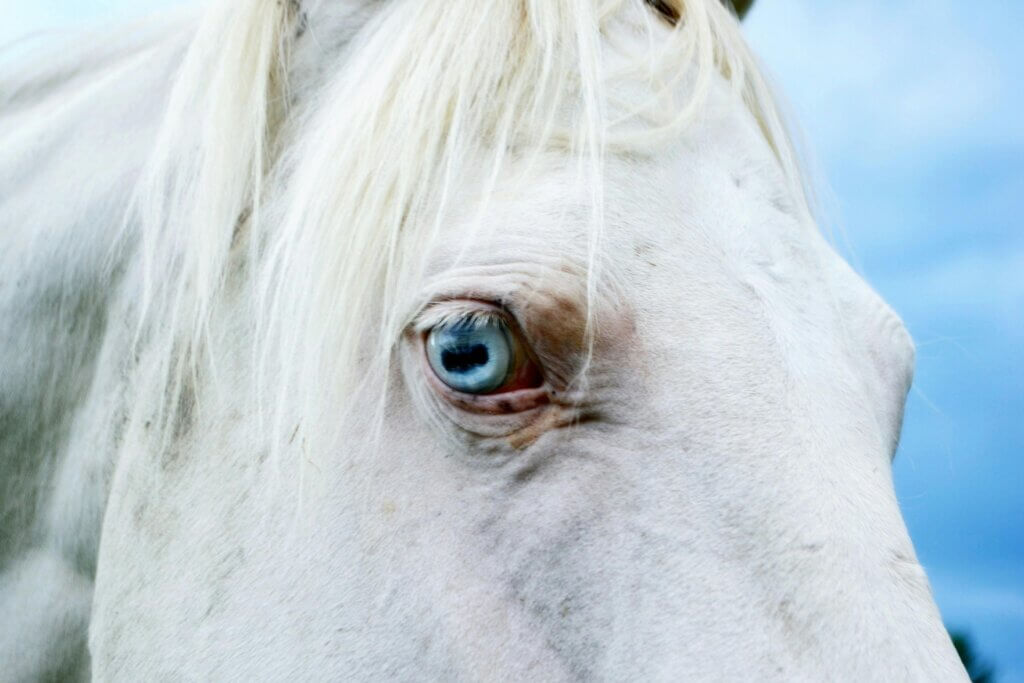
Most horses have brown eyes, but you’ll also see amber, hazel, and the striking blue-eyed horses.
Short answer: Blue-eyed horses see perfectly normally. Eye color does not affect visual acuity in horses.
What blue-eyed horses may experience:
- Slightly higher sensitivity to bright light
- More squinting or discomfort in direct sunlight
- Possible benefit from a fly mask with UV protection
But the vision itself? Completely fine. They’re not weaker or more sensitive overall, just worth keeping an eye on in harsh summer light.
A whole research on horses’ vision.
Why Do Horses Wear Blinders? The Real Reason
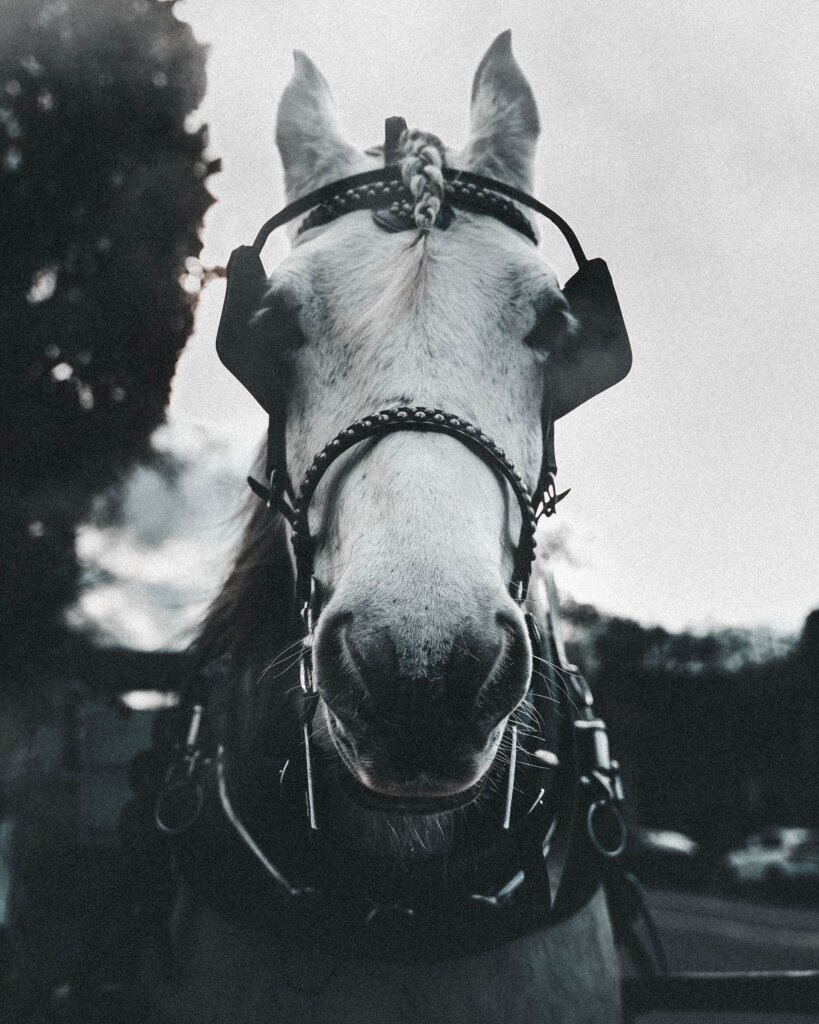
Blinders (also called blinkers) are cups or panels attached to a horse’s bridle that restrict what they can see to the sides. They narrow vision from around 350 degrees down to as little as 30 degrees, depending on the design.
Why would anyone do that to an animal with such impressive wide-angle vision?
Because sometimes, that wide angle is the problem.
For driving horses in traffic or crowded areas, the constant movement in peripheral vision can cause anxiety and spooking. Blinders keep them focused forward. For racehorses, they reduce distractions from other horses alongside them and help with gate behavior.
They are also used in training for green or nervous horses; less visual input can actually mean less overwhelm.
That said, blinders are not for every horse. Some perform better with them. Others become more anxious because restricted vision makes them feel more vulnerable. It’s always about the individual animal.
Fly Masks: More Than Just a Fashion Statement
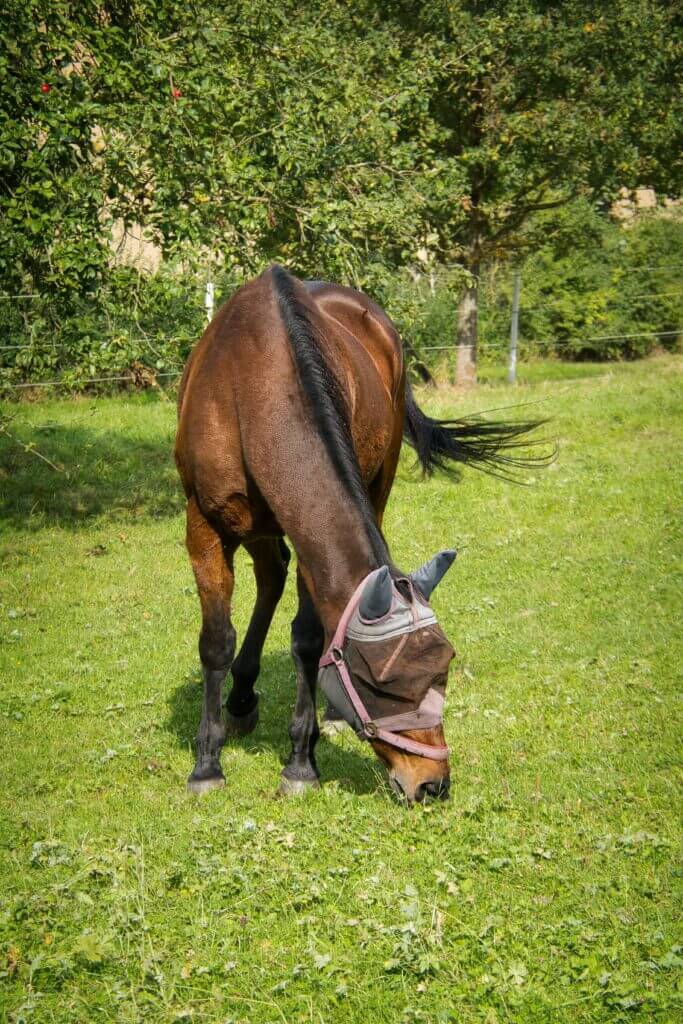
A horse fly mask is a mesh cover that protects the eyes, ears, and sometimes the muzzle from flies and insects.
You can read more about fly control for horses here
But it does more than keep bugs away:
- Creates a physical barrier that doesn’t wash off or wear out
- Blocks UV light — important for horses with pink skin or light-colored faces
- Reduces head shaking and stress caused by flies around the eyes
- Can help blue-eyed horses who are more light-sensitive
The mesh is fine enough that horses see clearly through it. Flies just can’t get through. Simple, effective, and very underrated.
What about those horse tears? Do Horses Cry? 5 Facts About Horses’ Eyes & Emotions
Let’s Walk Off
Wide. Motion-filled. And always asking: is this safe, or should I run? Horses aren’t looking at fine detail. They’re scanning for change. That’s the whole system. When you understand that, a lot of behaviour that seems irrational suddenly makes complete sense.
The spook at the same tree every Tuesday? The light changed. The hesitation at the puddle? They genuinely can’t tell if it’s 1 cm or 1 metre deep. The sideways jump at nothing? Something moved in the periphery. Work with it. Give them time to look. Be predictable. Respect the blind spots. The horse that feels safe is the horse that can actually focus on you.
FAQ
How far can horses see clearly?
Most clearly at about 1 to 1.5 meters in front of them. Beyond that, vision becomes more motion-based than detail-based.
Do horses recognise familiar objects?
Yes, through experience. But if an object moves or the light changes, they may treat it as new and potentially threatening.
Are some horses naturally spookier?
Yes. Thoroughbreds, for example, show stronger fear responses to novel objects compared to calmer breeds. Temperament is real, but training and handling matter just as much.
Do blue-eyed horses have worse vision?
No. Their vision is completely normal. They may be slightly more light-sensitive, but visual quality is unaffected.
Why does my horse spook at the same thing repeatedly?
Even a small change in position, shadow, or wind can make a familiar object feel new.
Should I force my horse toward scary objects?
No. Encourage, guide, and give time. Forcing creates panic. Patient desensitisation creates confidence.

Leave a Reply