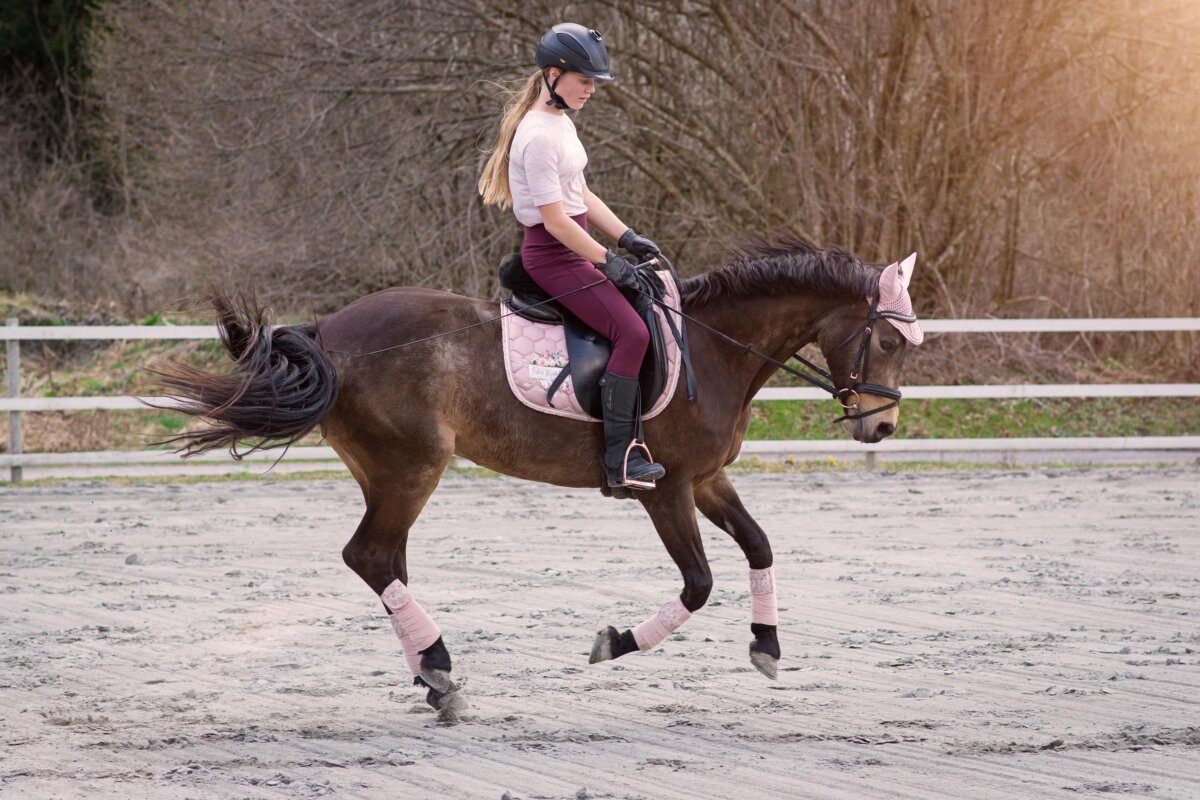
Okay, nice canter transition, here we go. You sit up, you give the aid, you think “I’m on it.” And then everything falls apart. The horse humps its back, throws in a buck, and boom, you’re grabbing mane and hoping for the best. Trust me, I’ve been there, done that.
So let’s actually get into it. Why do horses buck when asked to canter? Because a lot of them do, and it is way more common than most riders admit out loud. The good news is that horse bucking when asked to canter almost always has a reason behind it. Your horse isn’t plotting against you. It’s telling you something, and your job is to figure out what.
Why Do Horses Buck When Asked to Canter? The Short List
Horses buck when asked to canter for a handful of clear reasons, and in this article we’ll go through all of them one by one:
- Pain or a health issue
- Ill-fitting equipment, like the saddle, bit, or girth
- Not enough strength or balance yet
- Confusing or mixed-up aids
- Wrong timing or not enough preparation
- Not wanting to go forward, or testing you
- Too much energy, the horse feels fresh
We’ll also cover what to do about each one, right after we explain it, so you’ll walk away with an actual plan, not just a diagnosis.
Rule Out Pain and Health Issues First
Before you decide your horse is being difficult, check their health. This is genuinely step one whenever anyone asks why horses buck when asked to canter. Canter asks a horse to use its hindquarters and back in a much bigger way than walk or trot, so pain often shows up right there in the transition.
A few common culprits:
- Kissing spine or other back problems
- Teeth problems, like sharp points or wolf teeth catching on the bit
- Hip or hind-end problems
- Sore hocks or stifles
- Ulcers
If you’ve noticed any other odd signs, pinned ears, tail swishing, or general grumpiness under saddle, mention all of it to your vet. Don’t just say “he bucks at canter.” Give them the whole picture. Sometimes a horse bucking when asked to canter is the very first sign owners notice, before anything else looks wrong.
Check for Ill-Fitting Equipment
Yes, it can absolutely be the gear. A saddle that pinches or digs in right as the horse rounds up into canter is a classic cause, because that’s exactly when the horse needs to move freely through its back. A bit that doesn’t suit your horse’s mouth can cause the same kind of discomfort and confusion, and so can a girth that pinches or sits in the wrong spot.
What to do:
- Start with your vet to rule out the health issues above.
- A horse massage therapist or chiropractor can help if something feels tight or sore.
- A farrier can check the foot issues.
- A saddle fitter can check the saddle.
- A bit fitting specialist can help you find the right bit for your horse’s mouth.
If you want to understand more about bit fit and comfort, our article on Are Horse Bits Cruel? is a good next read.
Balance, Aids, and Timing
Once pain and equipment are ruled out, most horse bucks when asked to canter come down to balance and communication between you and your horse, and this is where a lot of the “why do horses buck when asked to canter” questions actually get answered. Here’s how to work through it.
Not Enough Strength or Balance Yet
Canter asks a horse to shift its weight back and push off with the outside hind leg. If the horse is young, green, or unfit, that shift can feel like being asked to sprint uphill with no warning. Losing balance mid-transition is scary for a horse, and a buck is often just them trying to find their feet again.
What to do: build strength slowly with hill work, pole work, and plenty of good quality trot work. Ask for canter on a straight line or a big circle at first, not a tight corner, so balance isn’t working against you too.
Pro tip: In this case, it can help to trot as fast as you comfortably can right before asking. The transition won’t be smooth, and that’s not the goal here, but it makes the actual jump into canter easier for the horse. It can give your horse a bit of confidence, and you can work on smoothness later, once the transition itself feels easy.
Your Position in the Saddle
Sometimes it’s not the horse, it’s us. If you grip with your knees, tense up, or lean forward right before the transition, your horse feels that and can lose their own balance because of it.
What to do: be prepared, not scared. Keep your hands soft and following instead of braced, and sit slightly behind the motion for the first few strides instead of leaning forward. A calm, steady seat gives your horse a much better chance of a smooth depart.
Confusing or Mixed Aids
If you’re wondering how to ask for canter correctly, the short version is: outside leg back, inside leg at the girth, a light seat and rein aid, given clearly and all together. Weird or mixed aids confuse a horse. If you’re nagging, kicking again and again, or asking for canter and then pulling back on the reins the moment it happens, you’re basically asking for go and stop at the same time. That’s one of the most common reasons behind horse bucks when asked to canter.
What to do: sharpen your canter aids at the walk and trot first, so the cue itself is clear and consistent, and give the horse a following hand the instant it canters instead of holding it back.
Pro Tip: Make sure your legs are consistent and not relaxing before the canter transition, and then suddenly they work like 3x force because it won’t stay unnoticed.
Wrong Timing or Not Enough Preparation
Asking for canter on a tight corner, mid-turn, or before your horse is warmed up and forward off your leg sets both of you up to struggle. A horse that’s already unbalanced or not moving forward well is far more likely to buck the second you add a canter aid on top.
What to do: make sure your horse is moving forward off a light leg aid at trot first. Ask for canter on a straight line or a large, open circle, and avoid corners until the transition itself is solid.
The Horse Doesn’t Want to Go Forward
Some horses buck at canter because they don’t want to go there. Maybe Canter has been uncomfortable before; maybe they’ve learned that a buck gets them out of work; or maybe it really is a case of testing you. If your horse is a bit behind your leg at walk and trot too, or tests you in other small ways on the ground, that attitude is going to show up loud and clear the moment you ask for more.
What to do: work on forward response and groundwork trust away from the canter question entirely. Once your horse moves off a light aid instantly and respects you on the ground, the canter transition usually stops being a fight. Our article on horse bonding goes deeper into building that kind of trust and respect.
When The Horse Feels Fresh
Sometimes it really is just too much energy with nowhere to go. A fresh horse that’s been standing in a stall, or one who genuinely loves to run, can throw in a happy buck the second canter kicks in. This one usually feels different from a pain-related buck. It’s bouncier, often paired with forward ears and a swishy tail of excitement rather than tension.
What to do: if your horse is fresh, ride lots of transitions. Transitions tire a horse out fast and keep their mind busy at the same time. Add in some new tasks or bending work, circles, serpentines, and other arena figures, so their brain has something to focus on besides all that extra energy.
A Mental Note for Riders
This part can feel scary, and sure, we tell ourselves we’re not afraid in the saddle. But if you’ve had a few rough transitions in a row, your body can start bracing for it without you even noticing. So take a deep breath before you ask. Watch that you don’t lean forward or grab the reins. Try to think of it as you and your horse being a team. You won’t always agree on everything, but it’s your job to show your horse that this is actually a good thing to do.
Let’s Walk Off
Look, a bucking canter transition is scary, and it can shake your confidence hard. But when people ask why horses buck when asked to canter, the answer almost always traces back to something specific: pain, ill-fitting equipment, a lack of balance, confusing aids, wrong timing, an unwilling horse, or too much energy. Work through the list in order: health first, then equipment, then your own riding, and you’ll usually land on the real reason your horse bucks at canter.
FAQ
Why does my horse buck every time I ask for canter?
It’s almost always one specific, repeatable trigger, like pain, ill-fitting equipment, or a confusing aid, rather than random misbehavior. When a horse bucks when asked to canter at the same point every time, that’s a helpful clue, since it points to something happening at that precise moment.
Should I stop riding if my horse bucks at canter?
If you suspect pain, stop and get your vet and saddle fitter involved before asking again. If you’ve already ruled that out and it’s a balance or aid issue, ride through it calmly and correctly.
Can a badly fitted bit cause bucking at canter?
Yes. A bit that pinches, is the wrong size, or doesn’t suit your horse’s mouth can cause real discomfort right when you pick up contact for the canter aid. If your horse is head-tossing or bucking mainly at canter, it’s worth having a bit fitting specialist take a look.
What’s the difference between a happy buck and a pain buck?
A happy or excess-energy buck tends to be bouncy, with forward ears and general looseness. A pain buck often comes with pinned ears, a swishing tail, or tension elsewhere in the body, like a hollow back or not wanting to move forward at all.
How long does it take to fix a horse that bucks at canter?
It depends on the cause. A saddle or bit fix can help almost right away. A balance or strength issue can take weeks to months of consistent, correct work. A trust or respect issue takes patience too, but steady groundwork usually shows progress within a few weeks.
All images used in this article are for illustrative purposes only. They do not depict the actual products discussed or reviewed, and they are not intended to demonstrate correct or proper horse training technique.

Leave a Reply