Disclosure: This post contains affiliate links. If you purchase through these links, I may earn a small commission at no extra cost to you.
Images used in this post are for illustrative purposes only and do not represent the exact products mentioned.
Looking at your horse’s hooves, and they’re dry like sand? Maybe some small cracks are forming, or the hoof wall just looks dull and kind of sad. You’re already mentally adding hoof moisturizer for horses to your Amazon cart. But before we get there, there’s actually a smarter order of operations, and skipping it is why a lot of riders spend money on horse hoof care products that end up doing way less than they could.
I got you. Let’s dive in.
In This Article
- A horse hoof is made of keratin, just like your nails — dead tissue on the outside, grown from live tissue at the coronary band
- Dry hooves and weak hooves are two different problems with two different fixes — moisturizing helps dryness, but weak hooves need internal support first
- Before putting any hoof moisturizer for horses on those feet, check that your horse is getting the right nutrition to grow healthy hoof from the inside out
- External causes of dry hooves include dry weather, dusty ground, and a wet-dry cycle.s
- Creating a damp patch near the water trough is free and surprisingly effective before you spend anything
- If you do buy a hoof conditioner, the four picks at the end cover every format: oil, butter, balm, and moisture-balancing formula
What Is a Horse Hoof Actually Made Of?
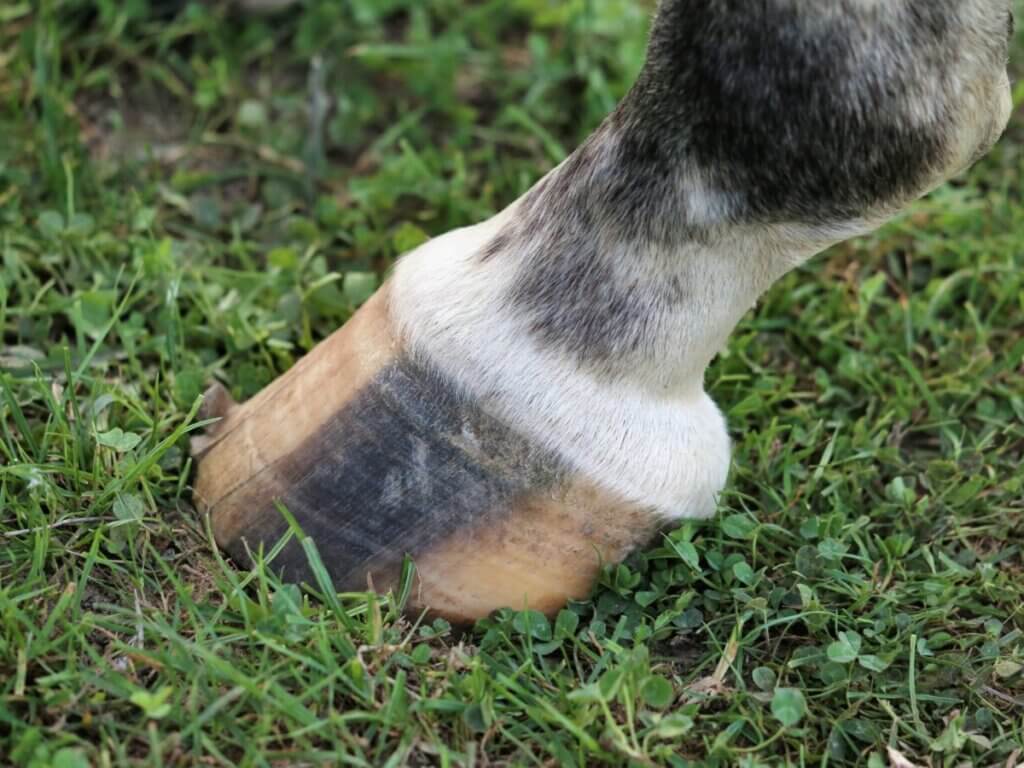
Okay, real talk: a horse hoof is basically a giant nail. Same material — keratin — same deal where the outer part is dead tissue and the living, growing part is up at the coronary band (that ridge where the skin meets the top of the hoof). New hoof wall grows from there, downward, at about three-eighths of an inch per month.
Because it’s dead tissue on the outside, you can’t actually repair it from the outside. You can condition it, protect it, slow down the damage — but the real foundation of a strong hoof is what’s happening at the coronary band. Which means nutrition and blood flow are doing most of the actual work, not the stuff you brush on.
For a full breakdown of hoof anatomy: Horse Hoof Anatomy — Mad Barn
Dry Hoof vs. Weak Hoof: Not the Same Thing
This is where most people get it wrong, and it genuinely matters.
A dry hoof is a moisture problem. It feels hard and brittle, looks dull, chips easily, and has surface cracks or flaking. This is exactly where a good hoof moisturizer for horses comes in handy.
A weak hoof is a structural problem. Thin walls don’t hold nails well, break at the edges, cracks go deep, and grow slowly. This is a nutrition and keratin quality issue. Putting conditioner on a weak hoof is like putting lotion on nails that keep breaking — looks better for five minutes, but doesn’t fix anything.
Let’s be honest, going to a horse show with dry hooves is not fun. But reaching for hoof oil when the real problem is your horse’s diet isn’t going to fix it either. Know which one you’re dealing with first.
Nutrition Comes Before the Conditioner
Before you buy anything, look at what your horse is eating. The hoof wall is built from biotin, zinc, copper, amino acids (methionine and lysine specifically), and omega fatty acids. If any of these are missing from the diet, no amount of topical conditioning will fix the problem because the new hoof growing at the coronary band will still be structurally weak.
Kentucky Equine Research recommends 15–20 mg of biotin per day for horses with hoof quality issues, and it takes 6 to 9 months to see a difference — because biotin only affects new growth, not existing hoof wall. Zinc and copper matter just as much. Omega fatty acids help build the protective outer layer of the hoof wall that regulates moisture from the inside out.
A vet or equine nutritionist can tell you whether your horse’s diet is actually covering these. Worth checking before buying supplements.
More on the research: Horse Hoof Health: Beyond Biotin — Kentucky Equine Research
External Causes of Dry Hooves
Once nutrition is sorted, look at what’s happening in your horse’s environment. Because honestly, you don’t always need a fancy hoof conditioner; sometimes, you just need a good farrier schedule and to stop accidentally drying out the hooves yourself.
Dry weather and dusty ground
The biggest culprits in summer. Low humidity plus hard, dusty paddocks pulls moisture out of the hoof wall fast.
Wet-dry cycles
Actually, more damaging than consistent dryness. Hooves that get soaked in morning dew then bake dry in the afternoon lose and regain moisture constantly, and that repeated swelling and shrinking weakens the hoof wall structure over time.
Hard surfaces
Concrete or gravel doesn’t dry the hoof directly, but they accelerate wear and creates micro-damage that dryness makes worse.
Genetics
White hooves are genuinely softer than dark ones, not a myth, an actual structural difference. Some horses just grow more porous hoof wall and lose moisture faster.
Before You Buy Anything: The Mud Trick
Here’s the thing. You probably don’t need to spend money on hoof care products immediately. Sometimes you just need some mud.
The most natural way for a horse to maintain hoof moisture is through ground contact with damp earth. In the wild, horses walk through dew, wet grass, and damp soil constantly. That ground moisture regulates hoof hydration passively and for free.
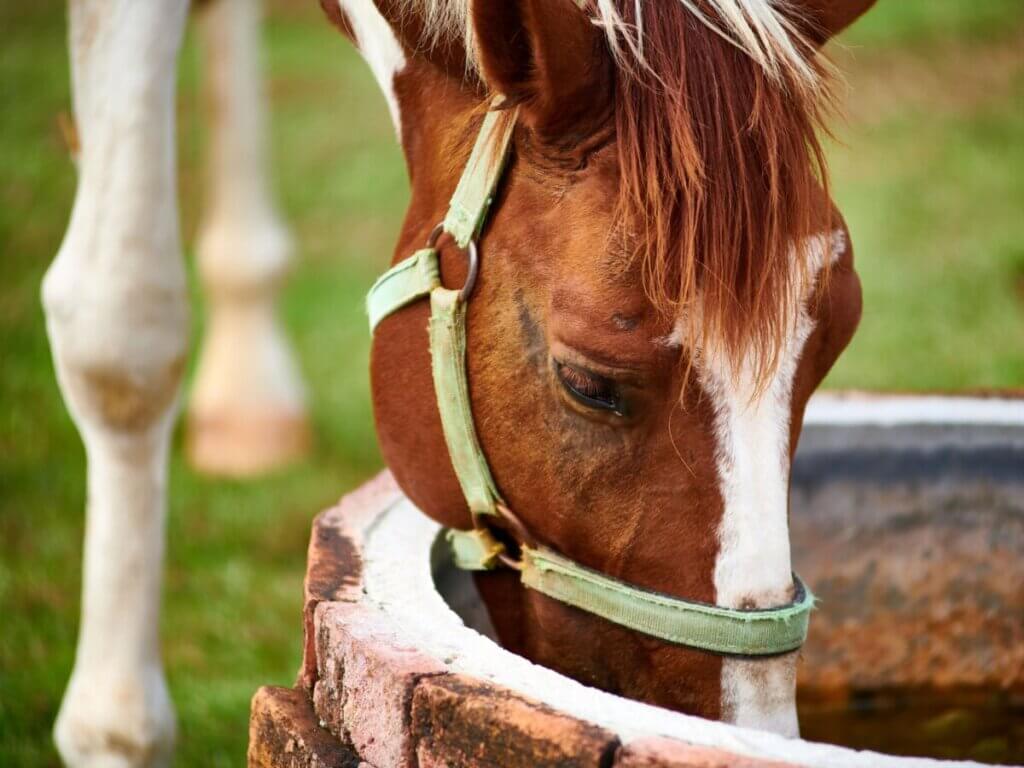
You can replicate this by creating a small damp patch around the water trough just enough that your horse stands in slightly moist ground while drinking. Minimal effort, zero cost, and for a lot of horses in dry summer conditions, it makes a real difference.
Side Note: Don’t do this if your horse is prone to thrush or white line disease, or if the ground gets genuinely waterlogged. Too much moisture invites bacterial problems. Damp, not swamp.
The Golden Rule of Hoof Oiling
Okay, this is important, and most people get it backwards.
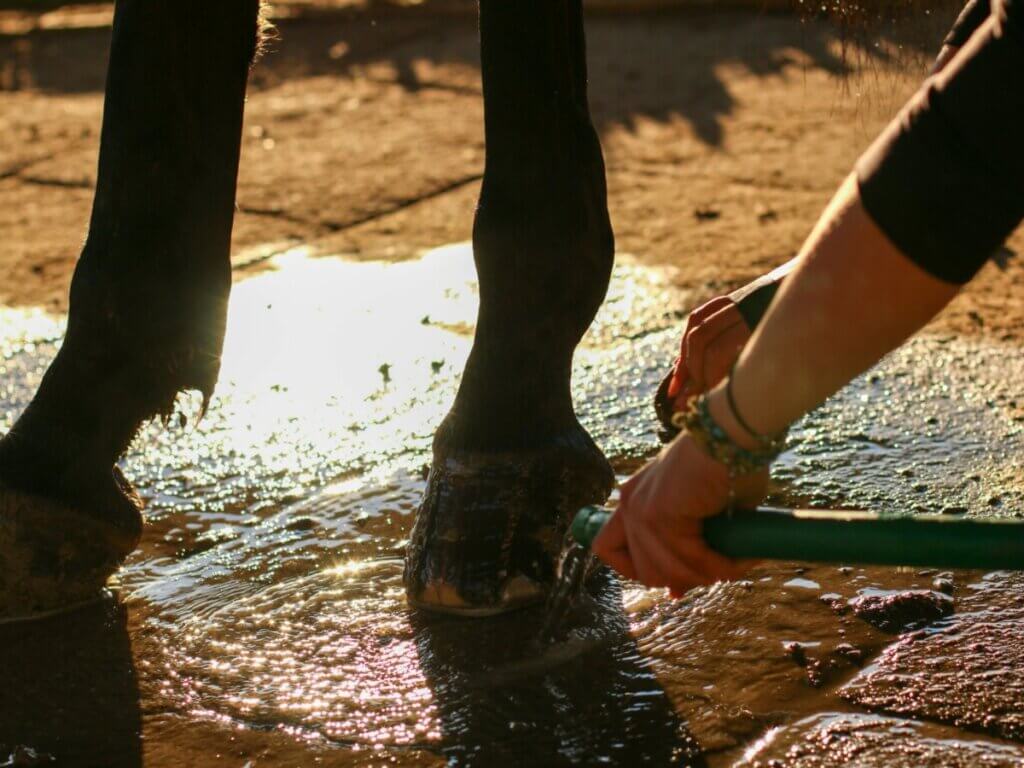
Always apply hoof moisturizer for horses to a wet hoof — never a dry one.
The whole point of a hoof oil or conditioner is to lock moisture in. If you apply it to a dry hoof, you’re sealing in… nothing. The oil creates a barrier, which is great, but that barrier needs something to work with.
Why a Hoof Conditioner Is Still Worth It
Even when nutrition is solid and the environment is reasonable, a good hoof moisturizer for horses has a real place in your routine.
A conditioned hoof has a natural sheen that an untreated hoof doesn’t. For competitions and shows, the difference is visible. And practically, a good conditioner creates a protective barrier that slows moisture loss in dry conditions and buffers the hoof against those damaging wet-dry cycles.
Some formulas penetrate deep enough to reach the periople and coronary band, actively supporting new growth rather than just sitting on the surface.
DIY Hoof Conditioner: Simple Recipe
You can absolutely make your own, and it’s genuinely easier than it sounds. Here’s a basic recipe with ingredients you can find at most grocery stores or online:
Simple Hoof Butter
- 3 tablespoons coconut oil
- 2 tablespoons shea butter
- 1 tablespoon beeswax pellets
- 1 tablespoon sweet almond oil (or olive oil)
- Optional: 3–4 drops of tea tree essential oil (natural antibacterial)
How to make it:
- Melt the beeswax pellets in a small heatproof bowl over a pot of simmering water (or 30-second bursts in the microwave).
- Add the coconut oil and shea butter and stir until melted together.
- Remove from heat, add the almond oil and tea tree if using, and stir well.
- Pour into a small tin or glass jar and leave to set at room temperature — takes about an hour.
- Done.
Storage: keeps for about 3 months at room temperature, longer in the fridge. The beeswax helps it hold its shape, but if your tack room gets over 85°F in summer, it will soften. Keep it somewhere cool.
The upside: you know exactly what’s on your horse’s hooves, clean ingredients, cheap per ounce, naturally antibacterial and antifungal thanks to the coconut oil and tea tree.
The downside: shorter shelf life than commercial products, no preservatives, and active ingredient concentrations aren’t as precise as a professionally formulated product. Great for maintenance on healthy hooves; if you’re dealing with serious cracking or structural issues, a commercial product will be more reliable.
The Picks: Hoof Conditioners Worth Trying
1. Farnam Horseshoer’s Secret Deep-Penetrating Hoof Oil
A farrier favourite for years. Uses avocado oil to deep condition, glycerine to attract moisture into the hoof wall, and mineral oil to lock it in. Thicker than most hoof oils, so it doesn’t run everywhere; absorbs faster than petroleum-heavy alternatives. A 32-oz bottle lasts a long time.
Review summary: Buyers consistently mention that it helps with cracks in dry climates and drought conditions. One reviewer noted it keeps cracks from spreading even in hard ground. Affordable, farrier-recommended, and reliable.
2. SOUND Hoof Conditioner
Uses essential fatty acids, omega-6 and omega-9 vitamins, and retinol that actually absorb into the hoof capsule instead of just coating the surface.
Review summary: Farriers and competitive horse owners who switch to SOUND tend to stay with it. A dressage horse owner reported visible improvement within one shoeing cycle after years of failed alternatives. Smells great, is safe to get on your hands, and has been tested in the field for over 20 years.
3. The Blissful Horses’ Hoof Butter
Handcrafted in Minnesota, all-natural ingredient list: shea butter, castor oil, argan oil, neem oil, coconut oil, beeswax, avocado oil, plus botanical infusions including comfrey, calendula, chamomile, and St John’s Wort. Easy to work into the sole and frog as well as the hoof wall. Natural antibacterial and antifungal properties make it useful for early signs of thrush or scratches, too.
Review summary: Buyers love the ingredient transparency and that it’s safe on their own skin. The consistency and scent are mentioned constantly. Note: melts above 90°F; store somewhere cool in summer.
4. HydroHoof by Red Horse Products
The most interesting formula here because it works differently. Developed with an equine podiatrist, built around bioactive honey as a natural moisture regulator. Instead of just adding moisture, it allows the horn to absorb only as much as it needs, which means it works in both dry and wet conditions without over-softening the hoof. Beeswax prevents moisture loss, bergamot oil conditions, and protects.
Review summary: One horse with persistent cracking through a long drought showed visible improvement within a week, and cracks growing out after two months of daily use. Natural ingredients, pleasant smell, developed with equine podiatry input.
Let’s Walk Off
Dry hooves and weak hooves are not the same problem, and the fix is different for each. Start with nutrition — make sure your horse is getting the biotin, zinc, copper, and amino acids needed to grow strong hoof from the coronary band down. Check the environment. Create some damp ground by the trough. Remember: always apply hoof moisturizer for horses to a wet hoof, not a dry one.
If you want to add a proper hoof conditioner to your routine, the four picks above cover every situation.
And if the hooves have been consistently bad despite good nutrition and care, loop in your farrier or vet before buying more products. Sometimes the answer is a trimming schedule, not another conditioner.
Related reading: Horse Bathing Guide — HorseRiderThoughts
FAQs
What does a hoof moisturizer for horses actually do?
It conditions the outer hoof wall and helps it stay flexible and resist cracking. Some products attract moisture into the hoof, some lock existing moisture in, and some do both. It’s a maintenance tool, not a repair tool. The new hoof has to grow for the real structural stuff.
Should I apply hoof conditioner to a wet or dry hoof?
Apply to a wet hoof so the conditioner seals in the moisture that’s already there. Applying to a completely dry hoof means the barrier has nothing to lock in.
How often should I apply hoof conditioner?
In dry summer conditions, every two to three days. In normal conditions, once a week alongside farrier visits is usually enough. Adjust based on how the hooves respond.
Can I use hoof conditioner on a shod horse?
Yes. Shod vs. barefoot matters less than the condition of the individual hoof. Apply to the hoof wall, sole, and frog as usual, just work around the shoe hardware.
My horse’s hooves are always dry, even with conditioner. What’s going on?
Consistently dry hooves despite regular conditioning usually point to a nutritional gap — most often biotin, zinc, copper, or omega fatty acids. Worth checking the diet before adding more topical products.
What’s the difference between hoof oil, hoof conditioner, and hoof butter?
Mostly format. Oil is liquid, absorbs fast, good for getting into cracks and the coronary band. Conditioner is thicker and creates more of a surface barrier. Butter is solid or semi-solid, making it easiest to work into the sole and frog. All three can moisturise; the best format is whichever one you’ll actually use consistently.

Leave a Reply